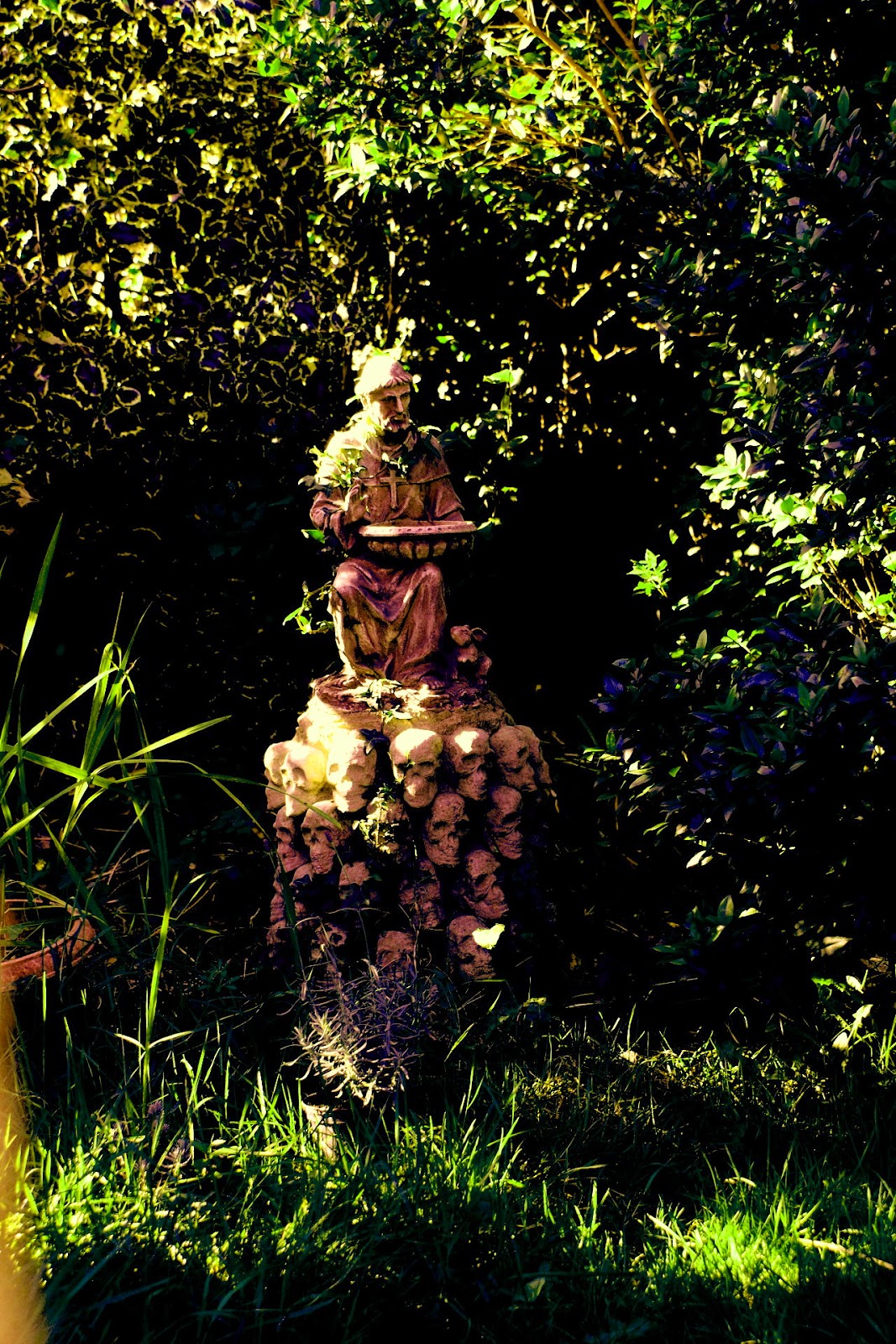
Wednesday, 15 October 2014

St Teresa of Ávila


“It is foolish to think that we will enter heaven without entering into ourselves.” 


Teresa of Ávila, also called Saint Teresa of Jesus, baptised as Teresa Sánchez de Cepeda y Ahumada (28 March 1515 – 4 October 1582), was a prominent Spanish mystic, Catholic saint, Carmelite nun, an author of the Counter Reformation and theologian of contemplative life through mental prayer. She was a reformer of the Carmelite Order and is considered to be a founder of the Discalced Carmelites along with John of the Cross. Teresa is one of the foremost writers on mental prayer, and her position among writers on mystical theology is unique. In all her writings on this subject she deals with her personal experiences. Her deep insight and analytical gifts helped her to explain them clearly. Her definition was used in the Catechism of the Catholic Church: "Contemplative prayer [oración mental] in my opinion is nothing else than a close sharing between friends; it means taking time frequently to be alone with him who we know loves us." She used a metaphor of mystic prayer as watering a garden throughout her writings. She was misunderstood, misjudged, opposed in her efforts at reform. Yet she struggled on, courageous and faithful; she struggled with her own mediocrity, her illness, her opposition. And in the midst of all this she clung to God in life and in prayer. She founded over a half-dozen new monasteries. She travelled, wrote, fought — always to renew, to reform. In her self, in her prayer, in her life, in her efforts to reform, in all the people she touched, she was a woman for others, a woman who inspired and gave life. In 1970, the Church gave her the title she had long held in the popular mind: Doctor of the Church. She and St Catherine of Siena were the first women so honoured. 


Saturday, 4 October 2014

St Francis of Assisi


“A man who works with his hands is a labourer. 
A man who works with his hands and his head is a craftsman. 
A man who works with his hands, his head, and his heart is an artist.” 

― St Francis of Assisi


Thursday, 2 October 2014

Holy Guardian Angels


The idea that each soul has assigned to it a personal guardian angel has been long accepted by the Church and is a truth of our faith. From the Gospel of today's liturgy we read: "See that you do not despise one of these little ones, for I say to you that their angels in heaven always look upon the face of my heavenly Father" (Matthew 18: 10). The Catechism of the Catholic Church states that "the existence of the spiritual, non-corporeal beings that Sacred Scripture usually calls 'angels' is a truth of faith (328).From our birth until our death, man is surrounded by the protection and intercession of angels, particularly our guardian angel: "Beside each believer stands an angel as protector and shepherd leading him to life (336)." The Church thanks God for our helpers, the angels, particularly on this feast day and September 29th (the feast of Archangels Michael, Gabriel and Raphael). Today's feast appeared in Spain during the 16th century. It was extended to the universal Church and made obligatory in 1670.

Wednesday, 1 October 2014

St Thérèse of Lisieux


"I prefer the monotony of obscure sacrifice to all ecstasies. To pick up a pin for love can convert a soul." These are the words of Thérèse of the Child Jesus, a Carmelite nun called the "Little Flower," who lived a cloistered life of obscurity in the convent of Lisieux, France. And her preference for hidden sacrifice did indeed convert souls. Few saints of God are more popular than this young nun. Her autobiography, The Story of a Soul, is read and loved throughout the world. Thérèse Martin entered the convent at the age of 15 and died in 1897 at the age of 24. She was canonised in 1925. The account of the eleven years of her religious life, marked by signal graces and constant growth in holiness, is given by Soeur Thérèse in her autobiography, written in obedience to her superior and published two years after her death. In 1901 it was translated into English, and in 1912 another translation, the first complete edition of the life of the Servant of God, containing the autobiography, Letters and Spiritual Counsels, was published. Its success was immediate and it has passed into many editions, spreading far and wide the devotion to this "little" saint of simplicity, and abandonment in God's service, of the perfect accomplishment of small duties. The fame of her sanctity and the many miracles performed through her intercession caused the introduction of her cause of canonisation only seventeen years after her death on 10 June 1914. Her feast day is celebrated on October 1st.


Wednesday, 3 September 2014

Pope St Pius X


Pius X worked night and day for the Church he so loved, while also being well aware of the enemies of the Church and did all in his power to thwart the Evil One from penetrating the sanctuary. He first addressed this in a decree entitled Lamentabili Sane, then followed that up with his no-nonsense encyclical Pascendi Dominici Gregis on 8 September 1907 which dealt with the condemnation of the evils of modernism. One of the results of this encyclical was the requirement that all priests take the Oath Against Modernism, something that also has been lost on the vast majority of priests and prelates from the lowest to the highest echelons today. Pius X spoke out repeatedly against the insidious and subtle attacks of liberals to infiltrate the Church with modernistic theories that watered down the true teachings as well as Christ's Own words. He warned of the dangers of those who offer the argument that the Church is out of touch and needs to modernise in order to relate with today's culture and society. This Pope was warning the world of what would occur in less than half a century when one of his successors would pronounce and adopt aggiornamento which was exactly what Pius X feared, but could never have imagined would actually occur. It did.

One would have thought, hoped and prayed that the Church he so loved would not have been pillaged as badly as it has. Pius X adamantly and wisely refused to be persuaded to the false humanistic manifesto, re-emphasising over and over that if it was good enough for Jesus, it was good enough for His Church in the 20th Century. Sadly, John XXIII thought differently. One was Catholic (Pius X), the other had abandoned Catholicism. He knew what Christ had set down would be attacked and he also knew that if he and his flock were loyal to Jesus, Christ's words in Matthew 16: 18 would encourage them to remain faithful.

Never one to compromise or capitulate when it came to Dogmas, Doctrines and the teachings of Christ and His Church, Pius X had more than a few run-ins with world powers Russia, the United States, Germany, Spain, Portugal, and of course, France. "Diplomacy be damned" was Pius' watchword if any of these countries promoted liberalism in any way. He sought to cut this evil off at the roots. He had meticulously studied Leo XIII's encyclical Rerum Novarum and realised the Communist threat as well as the even more insidious Freemasonry agenda and the clever way they had both crept in. Therefore, he sought to prevent any re-occurrence or allow it to infiltrate the Church by educating the faithful to the errors of Modernism, Communism and Freemasonry. For this he made more than a few enemies of the Church. Though he did not die a martyr, he felt like one as the world press attacked him from all angles. Yet Pius X stayed the course and would not waver from his convictions and his total dedication to Christ's holy cause. He cared not for what people thought, but what his Lord and Saviour thought, unlike the popes of Vatican II who base their programmes on pleasing man and incur the rebukes of the Apostle Paul in Galatians 1: 8-10.

Considered a holy person by many, public veneration of Pope Pius X began soon after his death. Numerous petitions resulted in an early process of beatification which started in the 1920s, coming to fruition in 1951. This which resulted in his canonisation on 29 May 1954. The Society of Saint Pius X, a Traditionalist Catholic group, is named in his honour. A gigantic statue of him is enshrined within Saint Peter's Basilica, while the town of his birthplace was also renamed after his canonisation.

While his reforming efforts bore fruit among the faithful, Pope Pius X was distraught over his inability to prevent the coming World War, which he accurately predicted would be a catastrophe for civilisation and the Church. He died on 20 August 1914, only weeks after the war began.

St Pius X was the first Pope to be declared a saint since the 1712 canonisation of the 16th century Pope St Pius V.


Friday, 1 August 2014

St Æthelwold


Today is the feast of Saint Æthelwold, Bishop of Winchester. He was born there of good parentage in the early years of the tenth century. After a youth spent at the court of King Athelstan, Æthelwold placed himself under Elphege the Bald, Bishop of Winchester, who gave him the tonsure and ordained him priest along with Dunstan. At Glastonbury, where he was dean under Saint Dunstan, he was a mirror of perfection. In 955 he became Abbot of Abingdon; and on 29 November 963 was consecrated Bishop of Winchester by Dunstan, with whom he and Oswald of Worcester worked zealously in combating the general corruption occasioned by the Danish inroads. At Winchester, both in the old and in his new minster, he replaced the evil-living seculars with monks and refounded the ancient nunnery. His labours extended to Chertsey, Milton (Dorsetshire), Ely, Peterborough, and Thorney; expelling the unworthy, rebuilding and restoring; to the rebellious "terrible as a lion", to the meek "gentler than a dove." The epithets "father of monks" and "benevolent bishop" summarise Æthelwold's character as reformer and friend of Christ's poor. Though he suffered much from ill-health, his life as scholar, teacher, prelate, and royal counsellor was ever austere. He was buried in Winchester Cathedral, his body being translated later by Elphege, his successor. Abingdon monastery in the twelfth century had relics of Æthelwold. He is said to have written a treatise on the circle and to have translated the "Regularis Concordia." He died on 1 August 984.

Thursday, 22 May 2014

St Rita of Cascia


Rita of Cascia was a wife, mother, widow and member of a religious community. Her holiness was reflected in each phase of her life.

Born at Roccaporena in central Italy, Rita wanted to become a nun but was pressured at a young age into marrying a harsh and cruel man. During her eighteen year marriage, she bore and raised two sons. After her husband was killed in a brawl and her sons had died, Rita tried to join the Augustinian nuns in Cascia. Unsuccessful at first because she was a widow, Rita eventually succeeded.

Over the years, her austerity, prayerfulness and charity became legendary. When she developed wounds on her forehead, people quickly associated them with the wounds from Christ's crown of thorns. She meditated frequently on Christ's passion. Her care for the sick nuns was especially loving. She also counselled lay people who came to her monastery.

Beatified in 1626, Rita was not canonised until 1900. She has acquired the reputation, together with St Jude, as a saint of impossible cases. Many people visit her tomb each year.