Friday, 18 April 2014

Good Friday


Good Friday at 3 pm (when Jesus died on the cross) there is the narrative of the Passion, and veneration of a relic of the True Cross. Jesus agonised on the cross for six hours. During his last three hours on the cross, from noon to 3 pm, darkness fell over the entire land. With a loud cry, Jesus gave up His spirit. There was an earthquake, tombs broke open, and the curtain in the Temple was torn from top to bottom. The centurion on guard at the crucifixion declared: "This Man truly was the Son of God!"
Joseph of Arimathea, a member of the Sanhedrin and secret follower of Jesus, who had not consented to His condemnation, went to Pilate to request the Body of Jesus. Another secret follower of Jesus and member of the Sanhedrin named Nicodemus brought about a hundred pound weight mixture of spices and helped wrap the Body of Christ. Pilate asked confirmation from the centurion whether Jesus was dead. A soldier pierced the side of Jesus with a lance causing blood and water to flow out, and the centurion informed Pilate that Jesus is dead.
Joseph of Arimathea took Jesus' Body, wrapped it in a clean linen shroud, and placed it in his own new tomb that had been carved in the rock in a garden near the site of crucifixion. Nicodemus also brought seventy-five pounds of myrrh and aloes, and placed them in the linen with the body, in keeping with the burial custom. They rolled a large rock over the entrance to the tomb.


Thursday, 17 April 2014

Holy Thursday


Holy Thursday is the most complex and profound of all religious observances, saving only the Easter Vigil. It celebrates both the institution by Christ himself of the Eucharist and of the institution of the sacerdotal priesthood (as distinct from the"priesthood of all believers") for in this, His last supper with the disciples, a celebration of Passover, He is the self-offered Passover Victim, and every ordained priest to this day presents this same sacrifice, by Christ's authority and command, in exactly the same way. The Last Supper was also Christ's farewell to His assembled disciples, some of whom would betray, desert or deny Him before the sun rose again.

Around the world, bishops and priests come together at their local Cathedrals on Holy Thursday morning to celebrate the institution of the priesthood. During the Mass, the bishop blesses the Oil of Chrism that will be used for Baptism, Confirmation, and Anointing of the sick or dying.

At this Mass, the bishop washes the feet of twelve priests to symbolise Christ’s washing of his twelve Apostles, our first bishops and priests.

Later that night, after sundown – because Passover began at sundown  the Holy Thursday Liturgy takes place, marking the end of Lent and the beginning of the sacred "Triduum,” or three, of Holy Week. These days are the three holiest days in the Catholic Church.

This Mass stresses the importance Jesus puts on the humility of service, and the need for cleansing with water, a symbol of baptism. Also emphasised is the critical importance of the Eucharist and the sacrifice of Christ’s Body, which we now find present in the consecrated Host.

At the conclusion of the Mass, the faithful are invited to continue Adoration of the Blessed Sacrament throughout the night, just as the disciples were invited to stay up with the Lord during His agony in the garden before His betrayal by Judas.

After Holy Thursday, no Mass will be celebrated again in the Church until the Easter Vigil celebrates and proclaims the Resurrection of the Lord Jesus Christ.


Wednesday, 16 April 2014

St Bernadette


On 16 April 1879, Bernadette - or Sister Marie-Bernard, as she was known within her Order - died in the Sainte Croix (Holy Cross) Infirmary of the Convent of Saint-Gildard. She was thirty-five.

Born into a humble family which little by little fell into extreme poverty, Bernadette had always been a frail child. Quite young, she had already suffered from digestive trouble, then after having just escaped being a victim of the cholera epidemic of 1855, she experienced painful attacks of asthma, and her ill health almost caused her to be cut off for ever from the religious life. When asked by Monsignor Forcade to take Bernadette, Louise Ferrand, the Mother Superior of the Sisters of Nevers, replied: "Monsignor, she will be a pillar of the infirmary."

At least three times during her short life-time, she received the last Sacraments. She was gradually struck by other illnesses as well as asthma: among them, tuberculosis of the lung and a tubercular tumour on her rightknee. On Wednesday, 16  April 1879, her pain got much worse. Shortly after eleven she seemed almost to be suffocating and was carried to an armchair, where she sat with her feet on a footstool in front of a blazing fire. She died at about 3:15 in the afternoon.

The civil authorities permitted her body to remain on view to be venerated by the public until Saturday, April 19th. Then it was "placed in a double coffin of lead and oak which was sealed in the presence of witnesses who signed a record of the events." Among the witnesses were "inspector of the peace, Devraine, and constables Saget and Moyen."

The nuns of Saint-Gildard, with the support of the bishop of Nevers, applied to the civil authorities for permission to bury Bernadette's body in a small chapel dedicated to Saint Joseph which was within the confines of the convent. The permission was granted on 25 April 1879, and on April 30th, the local Prefect pronounced his approval of the choice of the site for burial. Immediately they set to work on preparing the vault. On 30 May 1879, Bernadette's coffin was finally transferred to the crypt of the chapel of Saint Joseph. A very simple ceremony was held to commemorate the event.


St Bernadette was born at Lourdes, France. Her parents were extremely poor and she herself was in poor health. One Thursday, 11 February 1858, when she was sent with her younger sister and a friend to gather firewood, a very beautiful Lady appeared to her above a rose bush in a grotto called Massabielle. The beautiful Apparition was dressed in blue and white. She smiled at Bernadette and then made the sign of the cross with a rosary of ivory and gold. Bernadette fell on her knees, took out her own rosary and began to pray the rosary. The beautiful Apparition was God's Mother, the Blessed Virgin Mary. She appeared to Bernadette seventeen other times and spoke with her. She told Bernadette that she should pray sinners, do penance and have a chapel built there in her honour. Many people did not believe Bernadette when she spoke of her vision. She had to suffer much. But one day Our Lady told Bernadette to dig in the mud. As she did, a spring of water began to flow. The next day it continued to grow larger and larger. Many miracles happened when people began to use this water. When Bernadette was older, she became a nun. She was always very humble. More than anything else, she desired not to be praised. Once a nun asked her if she had temptations of pride because she was favoured by the Blessed Mother. "How can I?" she answered humbly and quickly. "The Blessed Virgin chose me only because I was the most ignorant." 

Her feast day is April 16th.


Monday, 17 March 2014

St Joseph of Arimathea


Today is the feast of Saint Joseph of Arimathea.

To unveil the beginning is to discover the truth, which is that the end is the beginning and the beginning the end. The scourged and crucified Body of Our Lord was raised from the dead and ascended into heaven. The cup sealed with His Precious Blood is the ultimate symbol of our union with God as Christ is the only way to the Father.


Tuesday, 11 February 2014

La belle Apparition à Lourdes


Bernadette Soubirous was born 7 January 1844, the eldest of six children belonging to Francois Soubirous and Louise Casterot. She was born Marie Bernarde, but was called Bernadette because she was so small. Bernadette was sickly her entire life, suffering from asthma even as a very young child. Her family was always poor, and for a time had to live in the cell of what used to be a prison, where they lived when the apparitions began. At the age of ten, Bernadette was sent for seven months to live with her aunt, both for the sake of her health – negatively affected by the cold winter that year – and because her father was having trouble finding enough work to feed his entire family. She returned once the weather and her health had improved, and her father was finding more work again.

St Bernadette Soubirous
In the summer of 1857, she left her home in Lourdes again to spend a few months with a woman, Marie Aravant, in a neighboring town with whom she had lived for a short time as a baby. She worked there as a shepherdess, and Marie Aravant also tried to teach her about the Catholic faith. Never having been properly schooled due to her poor health and her family's financial situation, Bernadette was not the best student. She returned to Lourdes where she began a day school run by the Sisters of Charity and Christian Instruction, beginning her first formal secular education as well as preparing for her First Holy Communion.

Apparitions

Shortly after returning to Lourdes, Bernadette's life changed forever when Mary chose to appear to her. On 11 February 1858, she was collecting firewood with her sister and a friend, when they left her behind to cross an icy stream. Bernadette did not go initially because of her poor health, but was about to take off her stockings to follow when she heard a rustling noise and saw a beautiful young woman in a small opening above the large grotto in the Massabielle rock. This was the first of eighteen apparitions Bernadette would experience.

Upon hearing what had happened, her parents initially did not want her to go back, thinking that she was hallucinating. Bernadette insisted, however, and the following Sunday she went again, taking holy water to sprinkle on the vision in case it was a demon. Friends who accompanied her began spreading the story when Bernadette saw the vision again, and more and more people became interested in what was going on. Many were still skeptical, including the local church authorities who tended to ignore such visions since most who claimed to see visions like these tended to be unbalanced or suffering from delusions. Civil authorities also tried to discourage Bernadette, trying to get her to admit that she was making up the story, or that she and her parents, who had eventually come to believe their daughter, were simply trying to profit from the frenzy that was continuing to grow as the apparitions became more widely known. In fact the opposite was true – even when people would come to visit Bernadette or her family, trying to give gifts of money or food, both she and her family refused all such offers.

The Hidden Spring

Over the course of the eighteen apparitions, Mary revealed to Bernadette a previously undiscovered spring in the ground under the grotto, instructed her to tell the priest to build a church at the site, and when he told Bernadette to make the vision give her a name, she eventually told Bernadette that she was the Immaculate Conception – a dogma that had been promulgated by Rome only four years earlier. Bernadette also said that Mary disclosed three secrets, but that she was not to tell anyone what they were.
Our Lady of Lourdes

After the sightings ended on 16 July 1858, many people continued to seek out Bernadette to hear the story from her own lips, to pray with her, or just to be in the presence of this amazing young woman who was blessed to have seen and talked with the Mother of God. For Bernadette, the swarms of visitors were a burden she felt she had no choice but to carry – she did not like or want the attention she received, but she never wanted to appear ungrateful or distant. Eventually she went to live at the convent where she had been taught so she could have some amount of privacy, but even here people went to see her. When she was twenty she decided to become a nun, and she moved away at age twenty-two to Nevers, France where the mother-house of the convent was located. Even her life here was full of trials, partially because the novice-mistress believed Bernadette must have become vain with all the publicity and attention she received and thus gave her many menial tasks to do. Bernadette did them happily, even when it was difficult for her because of her weak body. Throughout her years there, she became loved and regarded as a humble and willing servant who never sought acknowledgment for herself.

Sainthood

Even as a nun people went to visit her, to see the woman who some already regarded as saintly. Bernadette did not want to deny people the opportunity to see her if it might help to inspire them, but she did cherish her privacy. She also experienced much physical pain in her last years, developing a tumour on her knee, tuberculosis, and still suffering from asthma and other ailments. She died on 16 April 1879 at the age of thirty-five, and was buried in the convent grounds. In 1908, her casket was exhumed and her body found to be incorrupt and fresh as it was when it was buried thirty years earlier. In 1916 she was given the title of Venerable by Pope Pius X, and in 1925 was beatified. On the feast of the Immaculate Conception, 8 December 1933, Bernadette was canonised to the joy of many people. Today, her body is on display in the convent chapel in Nevers, and her feast day is celebrated on April 16th.


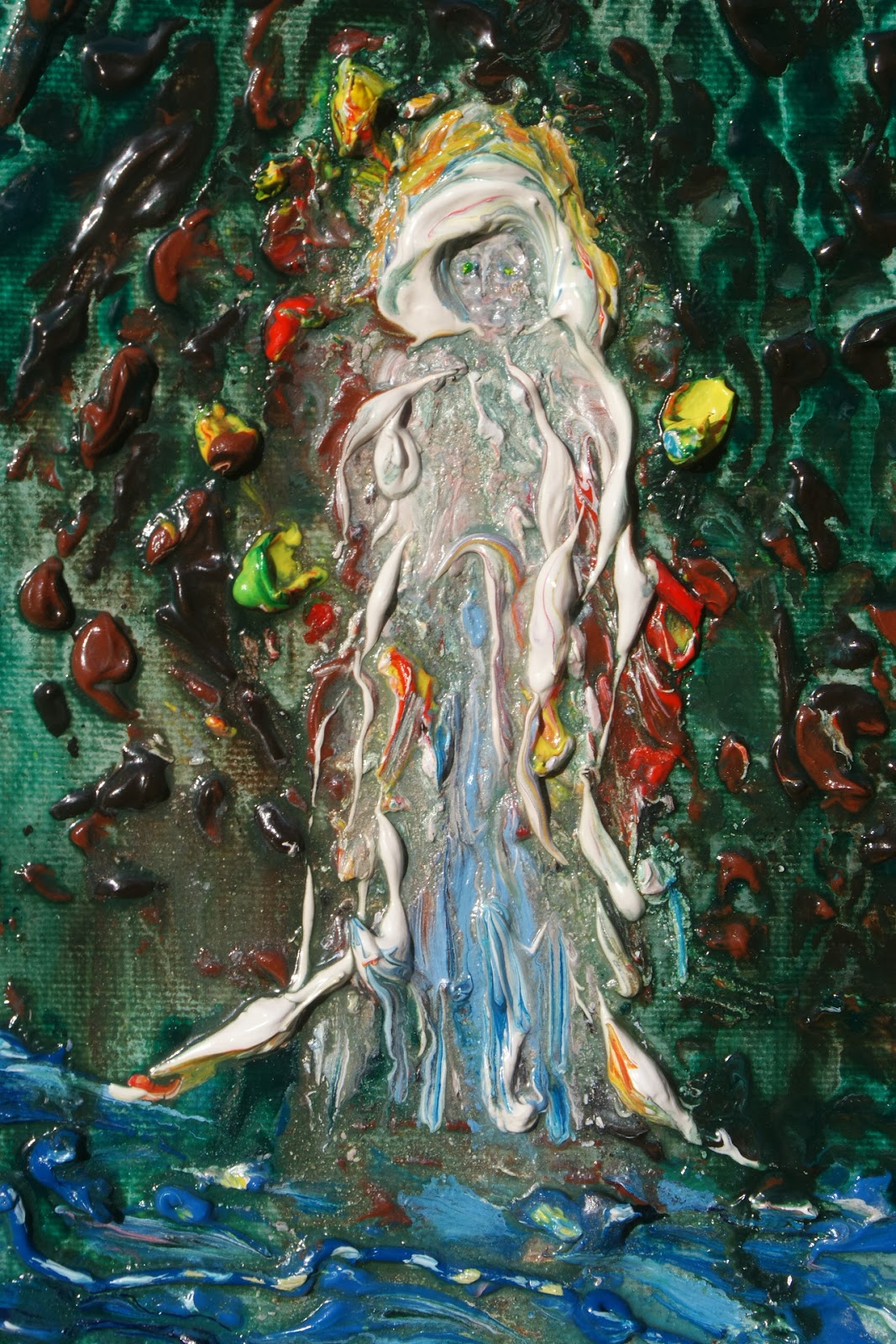
A detail of my own depiction of La belle Apparition à Lourdes (oil on canvas) appears below. To view the painting in its entirety, please click on the image. It can also be viewed at the Holy Grail Retreat.


Tuesday, 31 December 2013

Annum Nuova


Friday, 13 December 2013