Tuesday, 11 February 2014

La belle Apparition à Lourdes


Bernadette Soubirous was born 7 January 1844, the eldest of six children belonging to Francois Soubirous and Louise Casterot. She was born Marie Bernarde, but was called Bernadette because she was so small. Bernadette was sickly her entire life, suffering from asthma even as a very young child. Her family was always poor, and for a time had to live in the cell of what used to be a prison, where they lived when the apparitions began. At the age of ten, Bernadette was sent for seven months to live with her aunt, both for the sake of her health – negatively affected by the cold winter that year – and because her father was having trouble finding enough work to feed his entire family. She returned once the weather and her health had improved, and her father was finding more work again.

St Bernadette Soubirous
In the summer of 1857, she left her home in Lourdes again to spend a few months with a woman, Marie Aravant, in a neighboring town with whom she had lived for a short time as a baby. She worked there as a shepherdess, and Marie Aravant also tried to teach her about the Catholic faith. Never having been properly schooled due to her poor health and her family's financial situation, Bernadette was not the best student. She returned to Lourdes where she began a day school run by the Sisters of Charity and Christian Instruction, beginning her first formal secular education as well as preparing for her First Holy Communion.

Apparitions

Shortly after returning to Lourdes, Bernadette's life changed forever when Mary chose to appear to her. On 11 February 1858, she was collecting firewood with her sister and a friend, when they left her behind to cross an icy stream. Bernadette did not go initially because of her poor health, but was about to take off her stockings to follow when she heard a rustling noise and saw a beautiful young woman in a small opening above the large grotto in the Massabielle rock. This was the first of eighteen apparitions Bernadette would experience.

Upon hearing what had happened, her parents initially did not want her to go back, thinking that she was hallucinating. Bernadette insisted, however, and the following Sunday she went again, taking holy water to sprinkle on the vision in case it was a demon. Friends who accompanied her began spreading the story when Bernadette saw the vision again, and more and more people became interested in what was going on. Many were still skeptical, including the local church authorities who tended to ignore such visions since most who claimed to see visions like these tended to be unbalanced or suffering from delusions. Civil authorities also tried to discourage Bernadette, trying to get her to admit that she was making up the story, or that she and her parents, who had eventually come to believe their daughter, were simply trying to profit from the frenzy that was continuing to grow as the apparitions became more widely known. In fact the opposite was true – even when people would come to visit Bernadette or her family, trying to give gifts of money or food, both she and her family refused all such offers.

The Hidden Spring

Over the course of the eighteen apparitions, Mary revealed to Bernadette a previously undiscovered spring in the ground under the grotto, instructed her to tell the priest to build a church at the site, and when he told Bernadette to make the vision give her a name, she eventually told Bernadette that she was the Immaculate Conception – a dogma that had been promulgated by Rome only four years earlier. Bernadette also said that Mary disclosed three secrets, but that she was not to tell anyone what they were.
Our Lady of Lourdes

After the sightings ended on 16 July 1858, many people continued to seek out Bernadette to hear the story from her own lips, to pray with her, or just to be in the presence of this amazing young woman who was blessed to have seen and talked with the Mother of God. For Bernadette, the swarms of visitors were a burden she felt she had no choice but to carry – she did not like or want the attention she received, but she never wanted to appear ungrateful or distant. Eventually she went to live at the convent where she had been taught so she could have some amount of privacy, but even here people went to see her. When she was twenty she decided to become a nun, and she moved away at age twenty-two to Nevers, France where the mother-house of the convent was located. Even her life here was full of trials, partially because the novice-mistress believed Bernadette must have become vain with all the publicity and attention she received and thus gave her many menial tasks to do. Bernadette did them happily, even when it was difficult for her because of her weak body. Throughout her years there, she became loved and regarded as a humble and willing servant who never sought acknowledgment for herself.

Sainthood

Even as a nun people went to visit her, to see the woman who some already regarded as saintly. Bernadette did not want to deny people the opportunity to see her if it might help to inspire them, but she did cherish her privacy. She also experienced much physical pain in her last years, developing a tumour on her knee, tuberculosis, and still suffering from asthma and other ailments. She died on 16 April 1879 at the age of thirty-five, and was buried in the convent grounds. In 1908, her casket was exhumed and her body found to be incorrupt and fresh as it was when it was buried thirty years earlier. In 1916 she was given the title of Venerable by Pope Pius X, and in 1925 was beatified. On the feast of the Immaculate Conception, 8 December 1933, Bernadette was canonised to the joy of many people. Today, her body is on display in the convent chapel in Nevers, and her feast day is celebrated on April 16th.


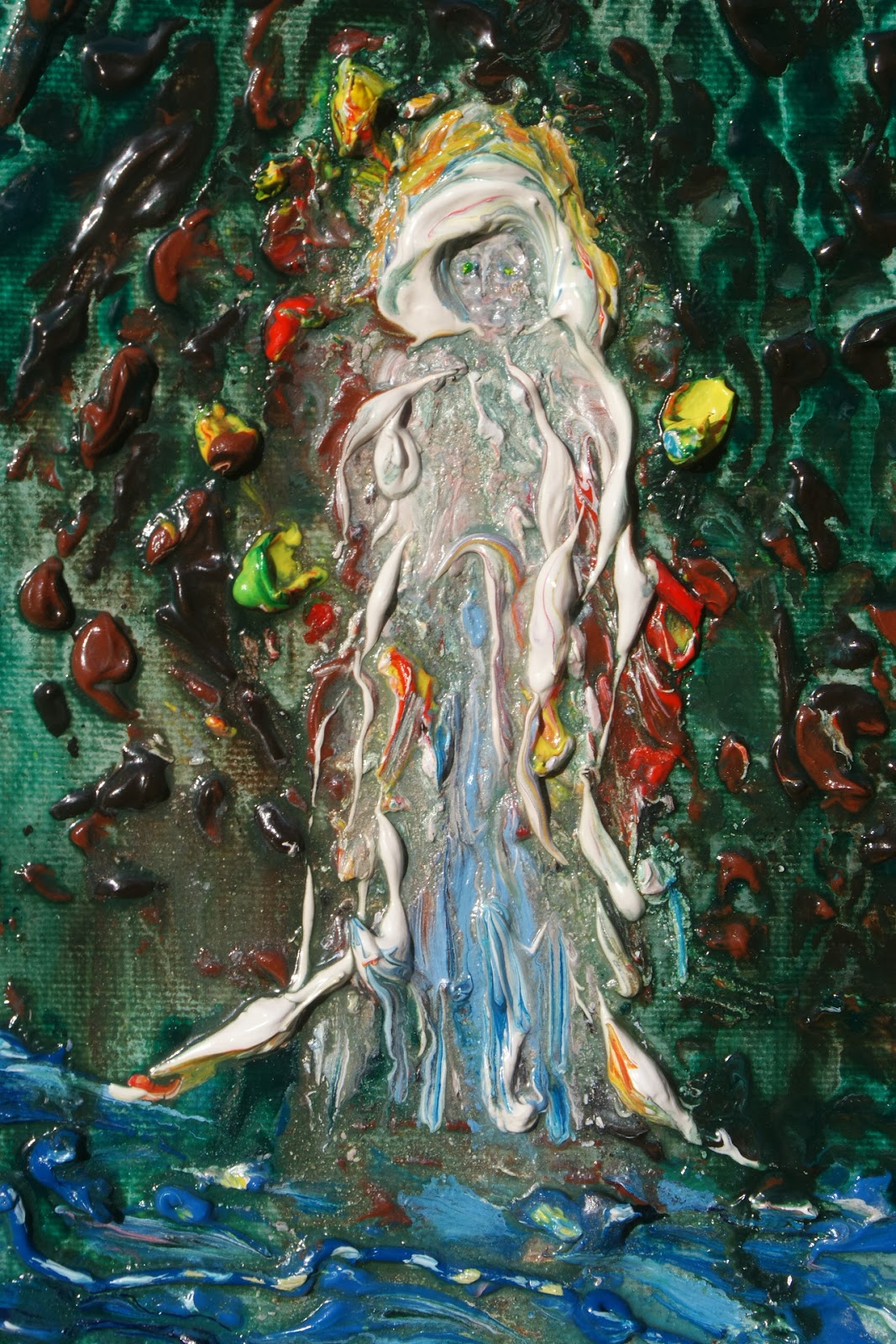
A detail of my own depiction of La belle Apparition à Lourdes (oil on canvas) appears below. To view the painting in its entirety, please click on the image. It can also be viewed at the Holy Grail Retreat.


Tuesday, 31 December 2013

Annum Nuova


†


Friday, 13 December 2013

†


Wednesday, 2 October 2013

Holy Guardian Angels


Today is the feast of the Holy Guardian Angels. The prayer to the guardian angels has been present in the Church since at least the beginning of the 12th century.

Guardian Angel Prayer:

Angel of God, my Guardian dear, to whom God's love commits me here, ever this day be at my side, to light and guard, to rule and guide. Amen.

Guardian Angel Quotes:

"The servants of Christ are protected by invisible, rather than visible, beings. But if these guard you, they do so because they have been summoned by your prayer. "

~ St Ambrose

“Let us affectionately love His angels as counselors and defenders appointed by the Father and placed over us. They are faithful; they are prudent; they are powerful; Let us only follow them, let us remain close to them, and in the protection of the God of heaven let us abide.”

~ St Bernard of Clairvaux

"God's universal providence works through secondary causes . . . The world of pure spirits stretches between the Divine Nature and the world of human beings; because Divine Wisdom has ordained that the higher should look after the lower, Angels execute the Divine plan for human salvation: they are our Guardians, who free us when hindered and help to bring us home."

~ St Thomas Aquinas


Tuesday, 1 October 2013

St Thérèse of the Child Jesus


St Thérèse of the Child Jesus and the Holy Face was buried in the Lisieux municipal cemetery on 4 October 1897. She was the first to be buried in the new plot her monastery had purchased in response to the city's new legislative directives prohibiting interment inside the cloister. In view of what took place after St Thérèse's death, it can now be said that the new directives were providential, since they enabled hundreds of thousands of pilgrims to visit her grave over a period of twenty-five years. Had St Thérèse been buried inside the cloister, this would never have been possible. Only in 1923 on the occasion of her beatification were her mortal remains transferred to the Carmelite chapel where they are kept to this day.


When people stand in the presence of the mortal remains of St Thérèse of Lisieux, or have some contact with her relics, as with petals from an unpetalled rose, God, who received through her humanity so many signs of love, is pleased in turn to manifest his love through her bodily remains.


From these poor signs, God's salvific power reveals and unfolds itself. It is enough to read the many volumes recounting favours and cures obtained through contact with St Thérèse's relics, as well as the abundant correspondence that arrives daily in Lisieux. 


We are indeed blessed at the Holy Grail retreat to be able to display numerous first class relics of St Thérèse at a dedicated shrine created for the purpose of veneration. Alongside her holy relics are those of beloved St Francis and St Clare of Assisi.

Sunday, 29 September 2013

St Michael the Archangel

.

Today is the feast of Saint Michael the Archangel (also the Feast of Saints Michael, Gabriel, Uriel and Raphael, the Feast of the Archangels, or the Feast of Saint Michael and All Angels).

Saint Michael is one of the principal angels; his name was the war-cry of the good angels in the battle fought in heaven against the enemy and his followers. Four times his name is recorded in Scripture:

(1) Daniel 10: 13 sqq., Gabriel says to Daniel, when he asks God to permit the Jews to return to Jerusalem: "The Angel [D.V. prince] of the kingdom of the Persians resisted me . . . and, behold Michael, one of the chief princes, came to help me . . . and none is my helper in all these things, but Michael your prince."

(2) Daniel 12, the Angel speaking of the end of the world and the Antichrist says: "At that time shall Michael rise up, the great prince, who standeth for the children of thy people."

(3) In the Catholic Epistle of Saint Jude: "When Michael the Archangel, disputing with the devil, contended about the body of Moses", etc. Saint Jude alludes to an ancient Jewish tradition of a dispute between Michael and Satan over the body of Moses, an account of which is also found in the apocryphal book on the assumption of Moses (Origen, De Principiis III.2.2). Saint Michael concealed the tomb of Moses. Satan, however, by disclosing it, tried to seduce the Jewish people to the sin of hero-worship. Saint Michael also guards the body of Eve, according to the "Revelation of Moses" ("Apocryphal Gospels", etc, ed. A. Walker, Edinburgh, p. 647).

(4) Apocalypse 12: 7, "And there was a great battle in heaven, Michael and his angels fought with the dragon." Saint John speaks of the great conflict at the end of time, which reflects also the battle in heaven at the beginning of time. According to the Fathers there is often a question of Saint Michael in Scripture where his name is not mentioned. They say he was the cherub who stood at the gate of paradise, "to keep the way of the tree of life" (Genesis 3: 24), the angel through whom God published the Decalogue to his chosen people, the angel who stood in the way against Balaam (Numbers 22: 22 sqq.), the angel who routed the army of Sennacherib (2 Kings 19: 35).

Following these Scriptural passages, Christian tradition gives to Saint Michael four offices:

To fight against Satan.

To rescue the souls of the faithful from the power of the enemy, especially at the hour of death.

To be the champion of God's people, the Jews in the Old Law, the Christians in the New Testament; therefore he was the patron of the Church, and of the orders of knights during the Middle Ages.

To call away from earth and bring men's souls to judgment ("signifer S. Michael repraesentet eas in lucam sanctam," Offert. Miss Defunct. "Constituit eum principem super animas suscipiendas,"  Antiph. off. Cf. The Shepherd of Hermas, Book III, Similitude 8, Chapter 3).


Sunday, 6 January 2013

Epiphany


The feast of Epiphany falls on January 6th and is the climax of Christmas, marking the end of the twelve days of Christmas and celebrating the visit of the Wise Men to the Messiah. These men are often called Kings or Magi. They brought valuable gifts of gold, frankincense and myrrh to honour the Divine Infant.

The gift of gold was the gift people usually gave to their King. By giving gold they were recognising Jesus as their King. The second gift, frankincense, is a white gum from a tree called Arbor Thurisfrom. After hardening the gum forms a hard resin which when burnt gives off a fragrant smell. It was burnt as an offering to God during worship, and is often used today as incense for sacerdotal ritual, especially during Mass, over the Easter period and at funerals. It is also used as medicine and as a perfume. The third gift was myrrh, which was also a gum from a thorny tree. Myrrh is a wound healer because it has antiseptic, anti-inflammatory and pain relieving qualities. It was used as an embalming material when someone had died.

Epiphany is the day when all Christmas decorations need to be taken down.

The day before Epiphany is the twelfth day of Christmas and is sometimes called Twelfth Night. In the Church calendar the Epiphany season lasts until the Tuesday before Ash Wednesday.

To unveil the beginning is to unlock the mystery of the end. For where the beginning is, there the end will be. Happy is he who stands at the beginning — he will know the end and will not taste death.

.